
Mind-Blowing the Statue of Liberty
Arvind M. Dhople, Ph.D.
Professor Emeritus, Florida Tech
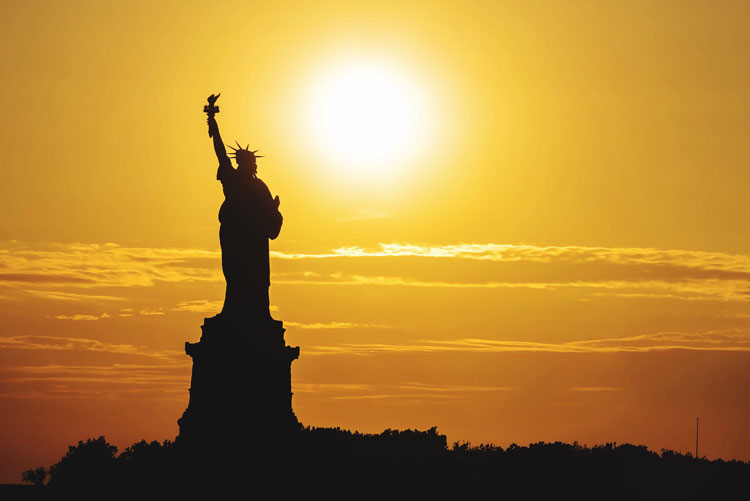
On October 28, 1886, as many as one million people flocked to Lower Manhattan to witness the unveiling of Liberty Enlightening the World (aka the Statue of Liberty in New York Harbor. This is a monument symbolizing the United States.
The Statue of Liberty was a joint effort between France and the United States, intended to commemorate the lasting friendship between the peoples of the two nations. The French sculptor Frederic-Auguste Bartholdi created the statue itself out of sheets of hammered copper, while Alexandre-Gustave Eiffel, the man behind the famed Eiffel Tower, designed the statue’s steel framework. The Statue of Liberty was then given to the United States and erected atop an American-designed pedestal on a small island in Upper New York Bay, now known as Liberty Island, and dedicated by President Grover Cleveland on October 28, 1886. Today, the Statue of Liberty remains an enduring symbol of freedom and democracy, as well as one of the world’s most recognizable landmarks.
Looming above New York Harbor nearby, the Statue of Liberty provided a majestic welcome to those passing through Ellis Island. On a plaque at the entrance to the Statue’s pedestal is engraved a sonnet called “The New Colossus”, written in 1883 by Emma Lazarus as part of a fundraising contest. It’s most famous passage speaks to the Statue’s role as a welcoming symbol of freedom and democracy for the millions of immigrants who came to America seeking a new and better life. “Give me your tired, your poor/Your huddled masses yearning to breathe free/The wretched refuse of your teeming shore/Send these, the homeless, tempest-tost to me/I lift my lamp beside the golden door”.
The Statue of Liberty was designated as a National Monument in 1924. Employees of the National Park Service have been caring for the colossal copper statue since 1933.
Roundup of monumental trivia
- In 1885, Bartholdi completed the statue, which was disassembled, packed in more than 200 crates, and shipped to New York, arriving that June aboard the French frigate Isere. Over the next four months, workers reassembled the statue and mounted it on the pedestal; its height reached 305 feet, including the pedestal.
- She may be old, but she gets the odd stretch in. In winds of 50 mph or more, her body can sway up to three inches and her torch arm, up to six.
- There are seven rays on her crown, one for each of the world’s continents. Together, they give her a hat that weighs more than 1,000 pounds.
- She has a face a mother could love – specifically, designer Bartholdi’s mother, who is rumored to have been the model for the green goddess’s massive visage. (Bartholdi’s wife posed for the arms and torso).
- Green is not her natural hair (or skin) color. At first, the statue was a dull copper brown. But as copper oxidized, it develops a patina to protect from further deterioration. By 1906, she was green from head to toe.
- The cost of building Lady Liberty and her pedestal was more than $500,000 – or at least $14 million today.
- She weighs 225 tons, but please don’t call her fat. The lady’s copper skin is extremely thin – less than 1/8 of an inch thick, to be exact.
- The statue represents a woman wearing a stola, a crown and sandals, trampling a broken chain, and with a torch in her raised right hand and a tabula ansata, where the date of the Declaration of Independence JULY IV MDCCLXXVI is written, in her left hand.
- Despite easy access to Manhattan’s shopping, the lady is a picky dresser. She wears a size 879 shoe and has a 35-feet waistline.
- She was a beacon of feminism from day one. When women were banned from attending the Statue’s dedication on what was then Bedloe’s Island, suffragists chartered a boat and held their own ceremony in the nearby harbor, loudly proclaiming the hypocrisy of men “erecting a Statue of Liberty embodied as a woman in a land where no woman has political liberty”.