
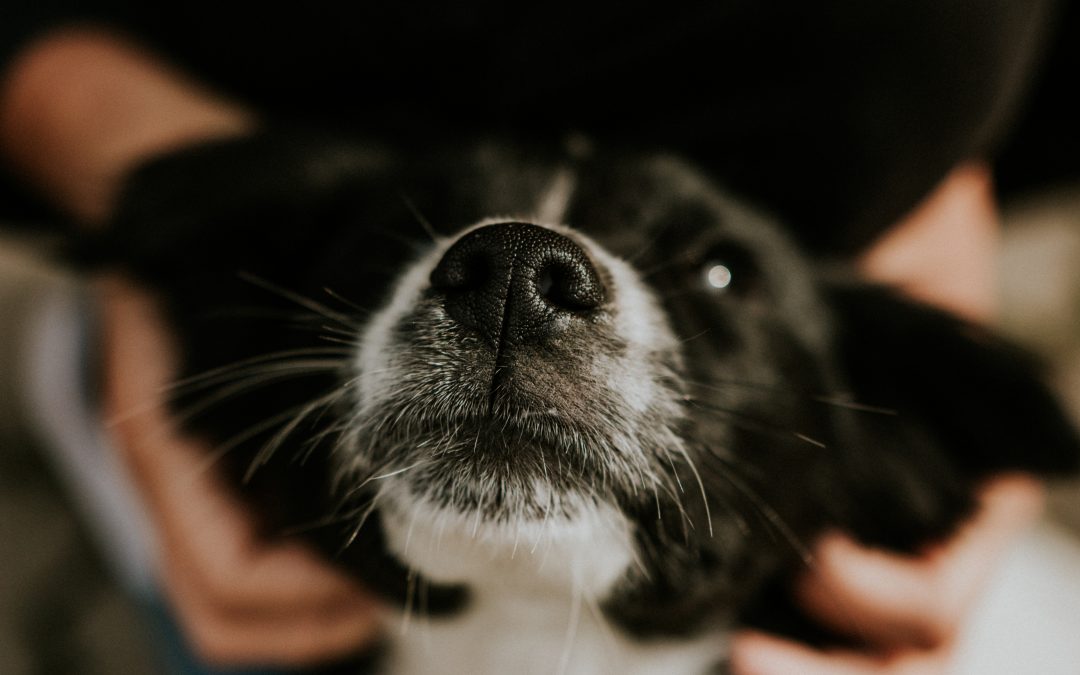
Dog: what the nose knows!
(How dogs can help with human health)
Arvind M. Dhople, Ph.D.
Professor Emeritus, Florida Tech
Certain diseases give off a distinctive smell, mostly undetectable to humans – but could dogs guide us to a new ways of detecting cancer? You are probably familiar with the concept of guide dogs, who are specially trained to help blind and partially sighted people during everyday life, but what about medical detection dogs?
These dogs work with individuals who have a range of diseases including type 1 diabetes, Addison’s disease, and narcolepsy. Using their incredibly attuned noses, these dogs are able to ‘sniff out’ minute indicators of changes in the body that could signal the onset of dangerous medical event. A dog’s sense of smell can be anywhere from 10,000 to 100,000 times more sensitive than ours, with the part of their brain dedicated to processing smells also being proportionally much larger.
For diabetes whose blood sugar levels change rapidly for example, the dogs are able to detect changes in blood sugar and alert their owners if the level falls below, or rise above, the normal range. They are also able to fetch help or medical supplies if needed. The dogs can also be placed with people with severe, life threatening allergies – a trained dog can detect an approaching person who had been eating nuts as far back as two days ago!
The first and foremost investigation into the early diagnosis of cancer is: (a) to assist scientists through research into the development of electronic systems (E noses) that will assist in the early detection of cancer through cheap non-invasive tests; and, (b) in the short time the “cancer-dogs” can provide second line screening for cancers that are currently very difficult to diagnose reliably, such as prostate cancer.
Prostate cancer is a major killer and the current test, the prostate specific antigen (PSA) test, is unreliable. If dogs can sniff prostate cancer from a urine sample the chances are high that from the results from the dogs’ sniffing research, a test can be developed that is far superior to the PSA test. A recent study on the ‘olfactory detection of prostate cancer by dogs sniffing urine’ is a step forward in early diagnosis.
The mass spectrometry scientists are planning to detect prostate cancer from human breath and urine. If dogs can sniff prostate cancer from a urine sample the chances are high that from the results of the dogs’ sniffing research, a test can be developed that is far superior to the PSA test. The results would indicate the existence of a potential odor signature of prostate cancer that may correspond to one or, more likely, multiple volatiles. We understand already that dogs can smell prostate from urine and are investigating identifying the different markers between PSA and cancer.
Similarly, we hope to find that volatiles from dogs also present in breath samples collected from breast cancer patient. In 2016, over 246,000 new cases of breast cancer are estimated to be diagnosed in women in the U. S. and just under 45,000 die. Under current procedures for detecting breast cancer, many women have to wait until they are fifty years old before they are invited in for their first mammogram. As someone who has had breast cancer significantly younger than fifty, it should be painfully aware that would have been too long for a woman to wait before being scanned for cancer for the first time.
So, if scientists succeed in proving that dogs can detect breast cancer on breath samples, younger women and women who had breast cancer and need regular checks to ensure the tumor has not returned, could simply breath into a tube and find out safely and quickly their state of health.
A recent study has tested the dog’s ability to distinguish exhaled breath samples of 31 breast cancer patients from those of the 83 healthy controls. Dog handlers and experimental observers were blinded to the identity of breath samples, obtained from subjects not previously encountered by the dogs during the training period. Among breast cancer patients and control, sensitivity was 0.88 and specificity 0.98. However, there were some limitations in the design of this study. And number of subjects included and further work is needed.
The work will eventually help scientists create an ‘electronic nose’ that could screen urine and breath samples. When though dogs will never replace doctors, there is hope that in future clinicians send urine and breath samples to be screened by the dogs.