
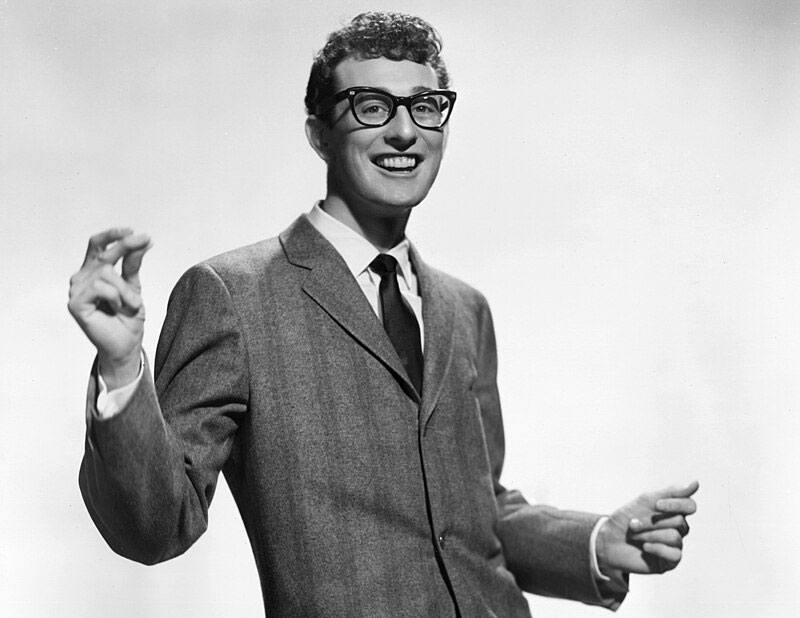
Buddy Holly- Revolutionary Performer, Writer and Artist
During September, we celebrate the birthday of Buddy Holly. Critic Bruce Eder has called Holly “the single most influential creative force in early rock and roll.” This statement covers some heady ground considering Elvis, Little Richard, Chuck Berry, Roy Orbison and Jerry Lee Lewis. His success lasted slightly under two years but did inspire the Beatles, The Rolling Stones, Dylan and Clapton.
In 1986, he was in the first class to enter the Rock and Roll Hall of Fame. Rolling Stone Magazine ranked Holly #13 among “The Fifty Greatest Artists of All Time.” Born September 7, 1936, in Lubbock, Texas, he was always called Buddy by his family. His older brothers taught him guitar, banjo, and steel guitar. His skills developed so rapidly that he won a talent contest at five years old.
He continued to sing and play his instruments well into junior high school when he met Bob Montgomery. They formed a bluegrass duo and performed at schools, talent shows, and local radio stations that featured regional acts. His junior high school and Lubbock High School also have honored Buddy. 1955 was a pivotal year for Holly. That year he saw Elvis perform and was impressed enough to incorporate a rockabilly sound into his band. Later that year, they opened for Presley in Lubbock and caught the eye of a Nashville talent scout. Holly continued his transition to rock and opened for Bill Haley & His Comets.
The Haley show led to a contract with Decca Records in February 1956. The contract misspelled his name from “Holley” to “Holly.” His Nashville recordings were a disaster. He had no input, and the sessions were confining. The sounds went nowhere, and on January 22, 1957, Decca informed him that his contract would not be renewed.
His reworked song, “That’ll Be The Day” from the John Wayne movie, “The Searchers,” topped the charts on September 23, 1957, in the United States as well as England. Things were exploding for the band. They made an appearance on the Ed Sullivan show on December 1 and sang “Peggy Sue” and “That’ll Be the Day.”
Somehow Holly and the Crickets were booked into New York’s Apollo for August 16-22, 1957. It took a few shows to win over the all-Black audience, but when they started to dance in the aisles, it was a new world in Rock and Roll. Holly fell in love with the music and publishing side of New York City. The Crickets wanted to return to Lubbock, but Buddy and his wife stayed in Greenwich Village.
New York was bursting with jazz, blues, and folk music. He wanted to collaborate with such artists as Ray Charles and Mahalia Jackson. He studied piano and finger-style flamenco guitar. He signed up to study acting at Lee Strasberg’s Actors Studio, where Marlon Brando and James Dean were graduates.
He started to experiment using the full capability of orchestral backing and that new recording technique called “Stereo.”
His royalties were being held up, and fearing a legal battle, Holly went on the road.
He was offered a tour in the Winter Dance Party, a three-week tour across the Midwest starting January 23, 1959. The other performers were Ritchie Valens and J.P. Richardson, known as The Big Bopper. Holly’s Crickets included Waylon Jennings on bass.
Long overnight travel in a bus without heat did nothing to keep them warm in the -25F temperatures.
On February 2, 1959, Holly chartered a plane to get him to the next city. Jennings gave up his seat so Valens could join Holly and Richardson.
Holly yelled at Jennings before taking off. “I hope your ol’ bus freezes up!” Jennings responded, “I hope your ol’ plane crashes!” The statement haunted Jennings until his dying day.
Holly’s funeral was held on February 7, 1959, in Lubbock. His headstone carries the correct spelling of his last name, “Holley.”
In 1971, Don McLean released his “American Pie,” which told of the day the music died.
Gary Busey starred in The Buddy Holly Story and received an Oscar nomination.
Holly was the first to organize a band with two guitars, bass, and drums. He wrote, produced, and performed his own songs. Holly bridged country, mountain, R&B, and pop.
The band the Beatles were named as homage to the Crickets.
“I play Buddy Holly every night before I go on; that keeps me honest.”-Bruce Springsteen
Buddy Holly released only three albums.
– Contributed by staff writer George Khoury