
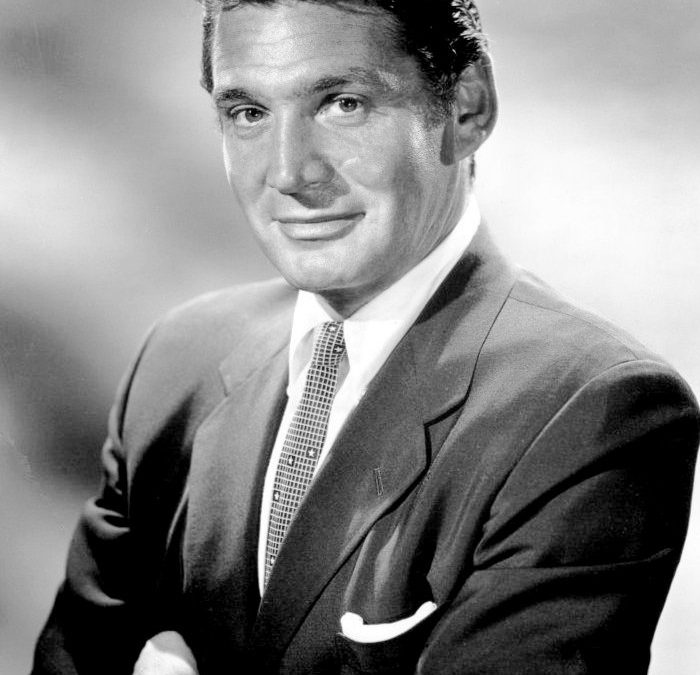
Gene Barry- Richer Beyond Money and Glamour
Little Eugene Klass, growing up in Brooklyn knew what his destiny would be. While in high school, he tried out for every theatrical production available. His only interests in school were the dramatic clubs and English class. “I was unlike any other boy. I was always careful not to sound like the guys on the street. I never ran with gangs or packs. I was always a well-dressed loner.”
Although a gifted violin prodigy with a baritone voice, he gave up the fiddle when he broke his arm playing football and focused on singing. While a senior in high school he won a musical scholarship to a school of music. After studying there for two years his persistence got him a regular job singing on the radio show, Arthur Godfrey’s Talent Scouts. After that, he took many jobs. While working in the Catskills, he changed his name to honor his acting idol-John Barrymore.
Gene realized that his future was the stage and in 1940 he caught a break when he joined the road company of “Pins & Needles.” Next came an off-Broadway play, then a 1942 production of “Rosalinda” and the aggressive and talented 21 -year old Gene was on his way and working regularly.
In 1944 a young actress Julie Carson and Gene met on a double date. Three weeks later Julie and Gene were married on October 22, 1944.
During the next two years Gene was in four plays and they all flopped. To earn money, Gene went back to theater and put together a nightclub act. “Never once did she nag me, discourage me or ask me to take work I didn’t want just so we would have no worries. She’s been my true partner from the first day of our life together. It’s because of her backing me all the way that I was able to finally make the grade. In a very real sense, I owe my success to her.”
Moving to Hollywood was good to them. In 1951 he got a Paramount contract for $1,000 a week and he made 20 films. He even appeared briefly in the Eve Arden television series, “Our Miss Brooks.”
But his fame was assured when he accepted the role of Bat Masterson. He was not impressed with doing a western but when he learned that the role would require him to be attired in black derby, polished boots, dark pin stripped suit with black tie, gold vest and a gold-headed cane, the clothes-horse jumped at the opportunity. “Bat Masterson certainly has been big for me. I, in turn, am crazy about him. He’s elegant, dapper and colorful, with human failings and human attributes. Not just a one-dimensional saddle type, but a sophisticated gentleman of the West.”
He stayed away from television for almost three years until the script for “Burke Law” was presented. The character seemed familiar. “He had a gentle manliness; he was a gentle man, a gentleman. I said, ‘O.K.’, let’s make a deal.”
Gene then became Captain Amos Burke, Chief of Detectives of the Los Angeles Police Department. Burke visited crime scenes in his chauffeur-driven Rolls Royce and lived in a magnificent mansion.
In September 1965 Burke was retired and reborn as “Amos Burke: Secret Agent.” His new series placed him as a rich agent who has the world as his back drop. The show was shot in black and white and died an early death when it went against “I Spy” which was shot in color and Burke in black and white.
Gene was very much a man of his time. He campaigned for Robert Kennedy and was on the podium the night of the assassination. He formed a production company and installed his children as producers and writers. He made guest shots on almost every television show and found a new career doing commercial voice-over work. Gene went back to his love of theater but now his lovely wife joined him on stage.
Gene lived a life as a working man, a family man and after gaining success-never forgetting where he came from. He was open to new adventures on television, Broadway, films and stage. He even played a homosexual lover in the musical La Cage aux Folles.
Gene Barry passed away on December 9, 2009 at the age of 90 years old.
“If you want to enjoy the simple things in life, you’ve got to be rich, Burke’s Law.” Gene Barry was rich in ways an accountant could never count.
Contributed by staff writer George Khoury